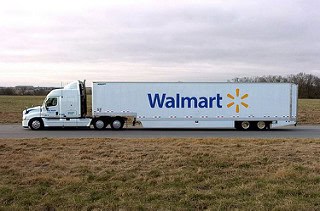
In the trucking industry, time is money, and on-time performance is key. While many companies penalize suppliers for late deliveries, Wal-Mart recently imposed even stricter time-based requirements. Find out what Wal-Mart’s new on-time performance regulations entail and how these new guidelines could impact the entire supply chain.
Situation: Wal-Mart Strives to Improve On-Shelf Availability
Like many major retailers, Wal-Mart has its fair share of issues with keeping the most in-demand items on store shelves. Despite scheduling almost back-to-back deliveries for its thousands of stores, the retailer has continued to struggle with keeping some of the most popular items in stock while balancing staffing needs at the loading dock and monitoring its bottom line.
This article is for Premium Members only. Please login below to read the rest of this article.
Not a Premium Member yet? Join today.
[login_form redirect=’https://www.ethanhathaway.com/’]
[show_to accesslevel=’Premium Members’]
Wal-Mart has already launched numerous programs that aim to improve on-time performance and increase its revenue. In fact, the retailer has such a long list of supplier rules that it regularly hosts summits to introduce new regulations and ensure that suppliers adhere to the many guidelines.
Some of Wal-Mart’s most persistent issues remained unresolved, however. After Amazon’s recent announcement of its intention to purchase Whole Foods Markets, Wal-Mart executives determined that its stores must improve on-shelf availability immediately in order to compete.
Approach: Wal-Mart Implements On-Time, In-Full Initiative
To fine-tune its stores’ complex delivery schedules, Wal-Mart announced its On-Time, In-Full (OTIF) initiative in July 2017. The initiative effectively penalizes suppliers for either early or late delivery as well as for incomplete orders.
According to Bloomberg Businessweek, Wal-Mart requires suppliers to deliver complete orders on the chain’s must-arrive-by date a minimum of 75 percent of the time. If items are missing from the orders or if they’re delivered late, suppliers must pay a fine equal to 3 percent of their value. Wal-Mart also levies a fine for early deliveries, since these create storage issues and overstock problems.
Impact and Advantage
Wal-Mart’s OTIF initiative launched at the beginning of August 2017, so it’s still too soon to tell what the true impact will be on the retailer’s supply chain. However, many industry experts have already weighed in with a range of concerns.
Thanks to its vast network of retail stores and distribution centers, Wal-Mart is responsible for large percentages of some of its suppliers’ sales. That means many suppliers, both large and small, must adhere to these new regulations in order to maintain their revenue streams. Yet some of Wal-Mart’s biggest suppliers, such as Unilever and Procter & Gamble, have an OTIF rate of about 10 percent. That means some suppliers will have to make substantial modifications to their own supply chains to meet these new guidelines.
Some industry experts suggest that even though Wal-Mart’s OTIF requirements are strict, they may become standard. Due to its size and influence, Wal-Mart has the power to push for substantial supply chain improvements, just as the retailer did when it encouraged the adoption of universal barcodes in the 1980s. If this new OTIF initiative pays off, Wal-Mart stands to gain an estimated $1 billion in revenue.
Suppliers, logistics professionals, and trucking executives are likely to benefit from paying close attention to the rollout of this OTIF initiative. Even those without direct connections to Wal-Mart should anticipate a push to improve efficiency and decrease errors in the supply chain.[/show_to]